
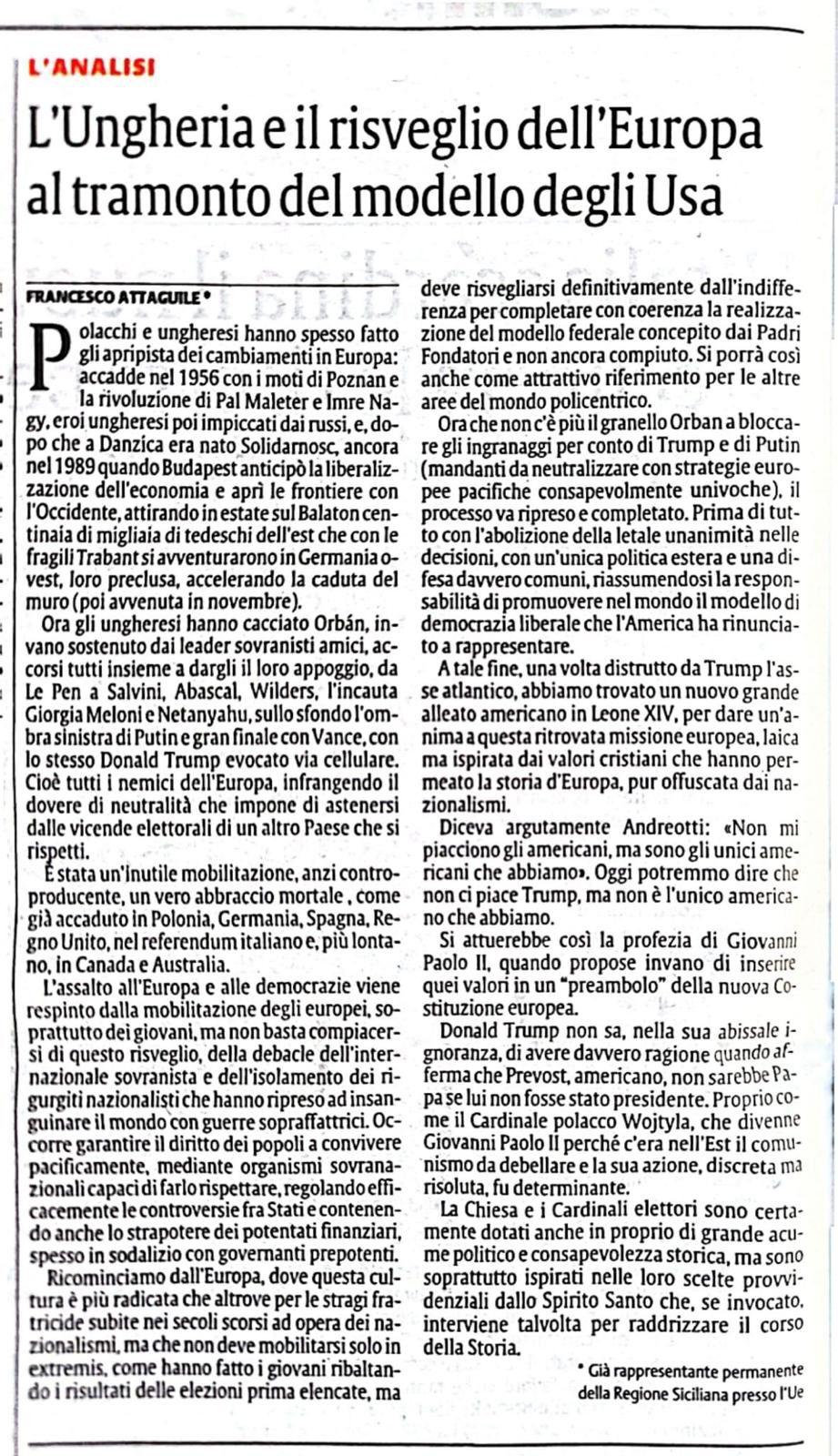
Hungary and the Awakening of Europe at the Sunset of the US Model
Author: Francesco Attaguile (Former Permanent Representative of the Sicilian Region to the EU)
The article analyzes a pivotal shift in European politics following a major electoral turning point in Hungary, framed within a broader decline of the United States as a global model of liberal democracy.
Key Points:
- Historical Role of Hungary and Poland: The author highlights how Poles and Hungarians have historically acted as trailblazers for European change, citing the anti-communist uprisings of 1956, the rise of the Solidarity movement in Gdańsk, and Hungary’s crucial role in 1989 in opening its borders to the West, which accelerated the fall of the Berlin Wall.
- The Downfall of Orbán: The text celebrates the recent electoral defeat of Viktor Orbán, noting that he was heavily—but unsuccessfully—backed by an international network of nationalist and sovereignist leaders (including Le Pen, Salvini, Abascal, Wilders, Meloni, Netanyahu, Vance, and Donald Trump via phone calls). The author criticizes this collective interference as a violation of electoral neutrality and defines it as a self-defeating “deadly embrace” (abbraccio mortale).
- The Path Forward for Europe: With Orbán no longer able to “throw a wrench in the gears” on behalf of foreign interests like Trump and Putin, Europe must fully awaken and complete its federal integration. To achieve this, the author argues that Europe must:
- Abolish the “lethal” requirement of unanimity in decision-making.
- Establish a genuinely common foreign and defense policy.
- Take on the global responsibility of promoting liberal democracy—a role the author claims the United States under Trump has abandoned.
- A New Geopolitical and Spiritual Alliance: The author suggests that while the traditional transatlantic axis under Trump has fractured, Europe can find a new American ally in the spiritual leadership of “Leo XIV” (seemingly a futuristic reference to a fictional or hypothetical Pope). This alliance would help revive a European mission that is secular but deeply inspired by Christian values, fulfilling a historical vision once proposed by Pope John John Paul II for the European Constitution.
- Conclusion: The article concludes with a reflection on the historical role of the Church, the Holy See, and the Holy Spirit in shaping providential historical turns—such as John Paul II’s role in ending communism in Eastern Europe—suggesting that spiritual insight and European unity are essential to rectifying the course of modern history against destructive nationalisms.


Leave a Reply