

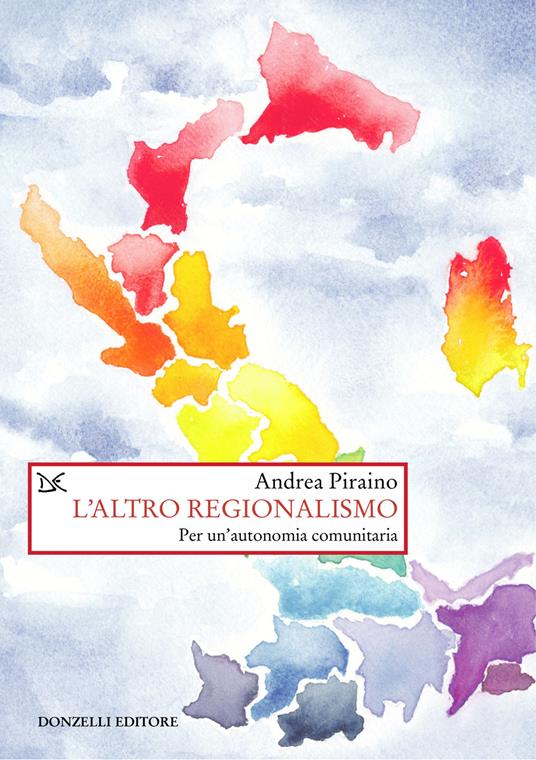
(Dall’introduzione dell’Autore, come pubblicata sul sito de La Feltrinelli): L’autonomia differenziata è un tema profondamente divisivo nel dibattito pubblico, come dimostra la sentenza della Corte costituzionale che ha dichiarato inammissibile la cosiddetta legge Calderoli – che disciplinava le procedure per il riconoscimento di «ulteriori forme e condizioni particolari di autonomia» alle Regioni ordinarie – evidenziandone i profili di illegittimità. Negli scritti raccolti in questo volume, il costituzionalista Andrea Piraino analizza debolezze e criticità del tradizionale regionalismo storico e propone un disegno alternativo di macroregionalismo comunitario. A un’autonomia differenziata che rischia di perpetuare le inefficienze e di inasprire la competizione tra Regioni, che presenta inoltre pericoli di rottura dell’unità repubblicana, di stravolgimento del principio di eguaglianza e di tutela dei diritti fondamentali, l’autore oppone – sulla base del negletto art. 117, comma 8, della Costituzione – un diverso modello regionale, basato sulla possibilità di creare delle intese tra le Regioni per migliorarne l’esercizio delle funzioni, attraverso la modifica dal basso dei confini regionali, e così attuare un moderno e funzionale macroregionalismo. Una nuova articolazione regionale, dunque, improntata al principio di solidarietà e in linea con la politica di coesione territoriale europea, che sia in grado di garantire risposte efficienti, efficaci ed economiche agli stessi problemi che presentano oggi vaste aree limitrofe, ad esempio in materia ambientale o in tema di sviluppo. Un ordinamento più equo, in cui il principio di libertà e quello di eguaglianza non restino dei meri enunciati ma supportino il pieno sviluppo della persona umana, e in cui la solidarietà politica, economica e sociale diventi un dovere comunitario inderogabile.

Synthesis
The article reflects on the current state of Italian institutional reforms and territorial governance. It uses the recent presentation of Prof. Andrea Piraino’s book, L’altro regionalismo (“The Other Regionalism”), in Catania as a springboard to discuss the decline of local autonomy, the rise of a new state-centralism, and the potential of European cross-border cooperation as an alternative pathway for Southern Italy.
Key Themes & Insights
1. The Health of Italy’s Institutional System
- From Autonomy to Centralism: Italy’s 1948 Constitution (Art. 114) and subsequent 2001 reforms established a “Republic of Autonomies” based on equal standing among the State, Regions, and Cities. However, the author argues that this romantic, historical ideal of localized autonomy is currently facing an involutionary crisis, giving way to a restoration of central state control.
- A Non-Partisan Trend: This shift toward centralism is not exclusive to the current populist/sovereignist government. The author notes that previous center-left administrations—such as the Letta government downsizing regional European dialogue and the Renzi government abolishing the Ministry for Territorial Cohesion—began this trend long ago.
2. Critique of the Calderoli Law (Differentiated Autonomy)
- The “Fiscal Residue” Problem: The article heavily criticizes Law 86/2024 (the “Calderoli Law”) on differentiated regionalism. The law relies on a purely accounting logic focused on “fiscal residue”—the difference between what citizens in wealthy northern regions (like Lombardy and Veneto) pay in taxes and what they receive back in public services.
- Constitutional and European Violations: The author argues that this law throws away decades of European cohesion policies meant to balance regional inequalities. While it is highly likely that the Constitutional Court will strike down the law for violating equal service guarantees (LEP) across the nation, the situation remains alarming.
3. The Shift in the European Union (EU Amnesia)
- From Cooperation to Militarization: The author expresses deep concern over a shift in the EU, which has abandoned its original pacifist mandate of using structural funds to bridge regional development gaps. Instead, it has begun diverting resource funding away from community development programs to finance weapons purchases for a third-party state—a move the author attributes to the structural interference of NATO in EU decision-making.
- Hyper-Competitiveness: This erosion of the cooperative model in favor of global market competitiveness is not new; the author points out it has roots stretching back to the presidency of Manuel Barroso, well before Ursula von der Leyen.
4. The Solution: Macroregions and GECT
To counter this rise of “neo-centralism,” the article looks toward democratic European mechanisms designed to bypass central state bottlenecks:
- European Macroregions: Sifting the territory into large macro-regions based on geographic continuity (there are currently five recognized, including the Alpine, Adriatic-Ionian, and Mediterranean).
- GECT (European Groupings of Territorial Cooperation): A more agile, less state-bureaucratic tool that allows cross-border cities and territories to enact joint policies. The author points to the real-world financial and institutional success of GECT GO (between Gorizia in Italy, and Nova Gorica / Šempeter-Vrtojba in Slovenia) as proof of concept.
- GECT ARCHIMED: Specifically focused on Mediterranean islands (highlighted by a star on its logo over the major islands), this group is currently designing joint projects in sustainable energy, education, culture, sport, and preventing hydrogeological instability. It leverages Article 174 of the TFEU, which recognizes “insularity” (being an island) as a valid criterion for receiving equalizing funds.
Conclusion & Future Outlook
The author concludes that Southern Italian Regions and Municipalities must urgently invest in these European institutional cooperation tools. Building a unified, structured representation of the South is the only way to withstand pressures from the Center-North, move past the short-sighted politics of emergency management, and cultivate a broad political vision suited to contemporary global complexities.


Leave a Reply